Building Inclusive Communities Through Restorative Practices
Building Inclusive Communities through Restorative Practices
Developed by Malik Muhammad, Ed.D.
This session will introduce restorative principles to educators and parents. These principles provide an alternative framework for thinking about and responding to wrong-doing or discipline problems both in school and at home. For those who are familiar with the basics of restorative practices, the session will foster a deeper understanding of key practices that prevent and heal harm, as we pursue the larger quest to build healthy communities where achievement and positive relationships are the norm.
Prepare for this session:
- https://www.pbs.org/video/in-close-restorative-justice/
- https://www.iirp.edu/restorative-practices/what-is-restorative-practices
- http://restorativesolutions.us/videos-on-restorative-practices-in-schools
- Read: Muhammed, M. (2019). The restorative journey book one the theory & application of restorative practices.
Session Objectives:
- Examine the shift in thinking that occurs for educators, students, and parents when schools move from punitive to restorative practices.
- Examine the elements (basic principles) of restorative practices.
- Think critically about how schools build community.
- Think critically about active listening, speaking individual truth, taking responsibility.
- Introduce and experience “Circles to Connect and Heal.”
A Suggested Icebreaker or Introductory Activity: My RP A
RP A stands for Restorative Practices Attitude. Since some in the group will be brand new to RP and others will have some level of exposure to Restorative Practices, it might be useful to “take the temperature” of the room by having participants introduce themselves (educator, school, grade level and subject taught, OR parent, student’s school and grade level) + their RP A. Pass around packets of card squares that include red, yellow, and green cards. Have participants select the color card that reflects the Restorative Practices Attitude that they bring to the training. The Red card indicates Reservation (I don’t know much about this, and I doubt that it can be the magic bullet for solving discipline problems). The Yellow card indicates Interest (I only know a little about this, but I am hopeful that it is a significant tool for solving discipline problems). The Green card indicates Commitment (I have some exposure to the ideas and practices, and I believe that they produce good results when a community really commits to use them). The workshop facilitator might collect the color cards presented as info on the level of “buy-in/resistance” present in the group. The facilitator concludes the activity by describing a bit about his/her RP Journey.
Session Activities for Educators and Parents:
Guided Conversation #1: Two Paradigms: Power-Based and Collective Based
Participants can work with a partner. Read A Tale of Two Paradigms. Answer the questions below:
- What are the characteristics of zero-tolerance (traditional) discipline approaches?
- What are the characteristics of restorative discipline practices?
- To what extent does each meet the needs of students, teachers, families?
- To what extent does each likely support improvement to the academic performance profile of the school?
Guided Conversation #2: Relationships*Relationships*Relationships!
Participants might work in school-specific groups using newsprint or poster board to answer the questions below. The groups might be tasked with creating one or more symbols/images to represent the State of Relationships in their school.
- How do schools build and foster relationships between staff?
- How do schools build and foster relationships between students?
- How do schools build and foster relationships between staff and students?
- How do schools build and foster relationships between families and the school?
Guided Conversation #3: Connection + Challenge = Change
Think about a minister or mentor whose advice you have sought and taken.
- How does your experience relate to this formula?
- What is the value of social capital in supporting individuals to change?
Guided Conversation #4: Understanding the Social Discipline Window
Participants Complete My SDS (Social Discipline Style) Worksheet
- In which box is your SDS located most of the time when you consider your work with students?
- Did you find yourself in multiple boxes?
- What influences your placement in the predominant box?
- Is your placement different when you are with family and colleagues? If so, why?
- If your school were assigned an SDS, in which box would it be located?
Guided Conversation #5: The Issue of Shame and Its Impact on Positive Discipline
Read more about the issue of shame:
- What does shame have to do with restorative discipline?
- How is shame destructive to ourselves and others?
- How can shame be “harnessed” to help transform behavior?
Guided Conversation #6: Affective Language and Restorative Questions
- What is affective language?
- How accessible is it to most people and under most circumstances?
- What are restorative questions? How do they make use of affective language? How are they different from questions that an administrator, in a zero-tolerance environment, might pose to a student who is written up by a teacher for disrespectful behavior or fighting?
Guided Conversation #7: The Magic Circle: The Power to Connect and Heal
Refer to and/or play videos referenced in the Prepare for the Session instructions.
- What gives the Circle its special meaning in restorative work?
- What are the mechanics of organizing a circle in a classroom? Is it necessary to have participants sit in a circular arrangement or is the Circle a conceptual element that signifies something that the convener wants to convey?
- How are proactive and reactive circles different?
A Concluding Conversation:
Allow each school team to meet to record their preliminary ideas for putting the session content into action. Each school team is assigned to complete the Moving from Talk to Action form. Team members might identify personal “aha moments” and influential ideas from the training.
Homework Assignment: Moving from Talk to Action
Each school team is tasked with identifying one or more ideas presented during the training that they will share within their school communities (teachers to teachers and parents to parents) as promising practices that the school might embrace.
What new or modified discipline strategies will the team recommend for their school’s plan? Consider a single strategy that might support development of supportive, respectful, trusting relationships.
A Journaling Prompt:
Think of a student who is not succeeding in your class or who has been suspended out of your class or school. On a scale of 1(low value of student connection) to 10 (highest value of student connection). Rate how connected you feel to the student. Do you know the student’s friends? Do you know what the student achieves most success in doing? Do you know the student’s ideas and plans for his/her future (work and community life)? Do you know who the student respects in his/her family or community? What action does this assessment lead you to consider?
To Learn More:
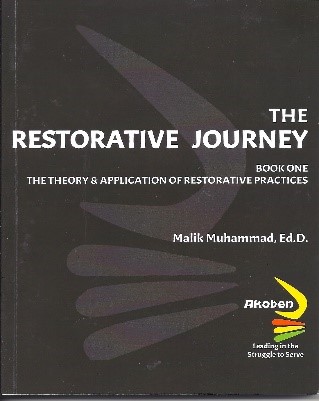
This is the primary text for this workshop.
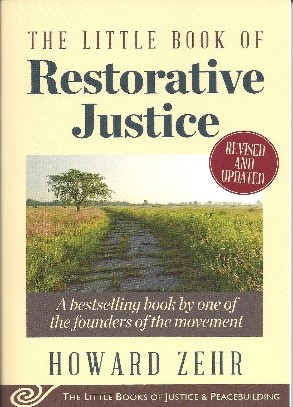
This author is a founder of the Restorative Justice movement.
Additional Books
Block, P. (2009). Community: The structure of belonging. Oakland, CA: Berrett-Koehler.
Boyes-Watson, C. (2008). Peacemaking circles and urban youth: Bringing justice home. St. Paul, MN: Living Justice Press.
Braithwaite, J. (1989). Crime, shame and reintegration. Cambridge, UK: Cambridge University Press.
Costello, B. and Wachtel, J., et al. (2019). The restorative practices handbook. Bethlehem, PA: IIRP.
Covey, S. (2013). The 7 habits of highly effective people. Anniversary Edition. New York, NY: Simon & Schuster.
Fitzgerald, M. (2006). Corporate circles: Transforming conflict and building trusting teams. Buffalo, NY: Quinn.
Pranis, K. (2005). The little book of circle processes: A new/old approach to peacemaking. Battleboro, VT: Good Books.