Immigrants' Rights

The fundamental constitutional protections of due process and equal protection embodied in our Constitution and Bill of Rights apply to every person, regardless of immigration status.

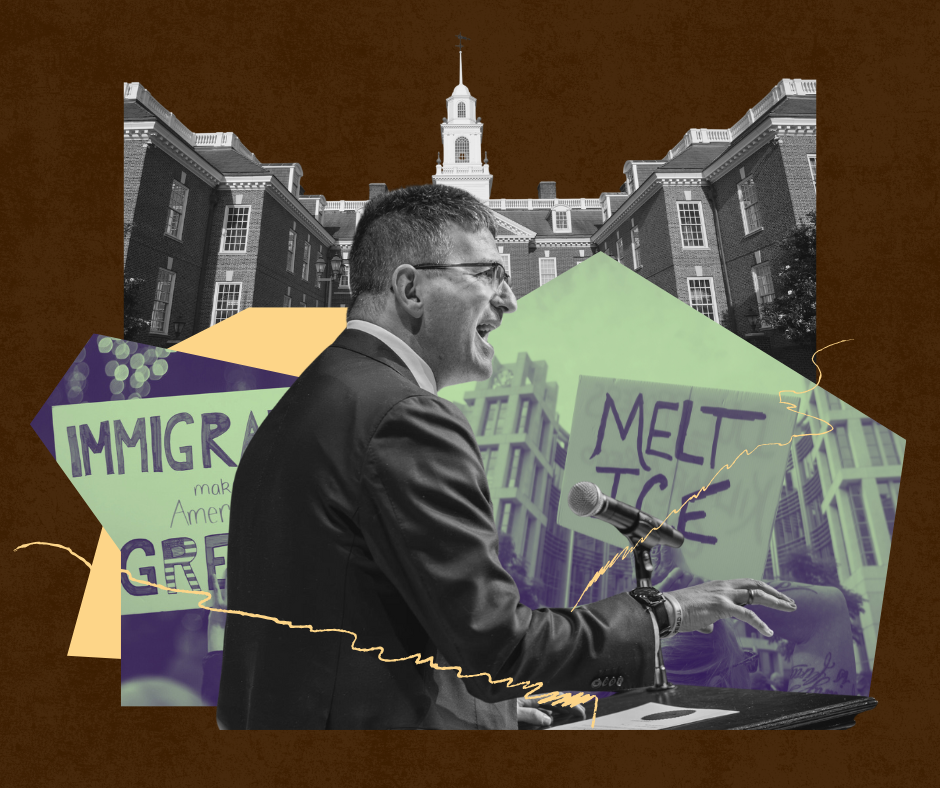
Immigrants make our communities stronger.

What you need to know

1 in 10

Delaware residents is an immigrant

Over 62,000

Delaware residents had at least one immigrant parent in 2015

The fundamental constitutional protections of due process and equal protection embodied in our Constitution and Bill of Rights apply to every person, regardless of immigration status.

Yet we know that immigration status has an enormous impact on the way many people in our community are treated, as well as the opportunities and systems they can and cannot access. From employment to housing to education, there are numerous obstacles that are unfairly levied against immigrants both in our state and the nation at large. Discrimination on the basis of immigration status threatens the civil rights of some of our most vulnerable members of society, and we will not tolerate it.

At the ACLU of Delaware, we are working to enforce and expand protections for immigrant communities in Delaware and ensure that everyone's rights are respected, regardless of status, language, or country of origin. Our work includes fighting to increase legal protections for workers, conducting more education and outreach around civic-engagement for non-English speakers, and building strong coalitions in the state for community members to stand together against the barriers of xenophobia.


The Latest

Podcast
ENTRE NOSOTR@S con Charito

Programa Radial Entre Nosotr@s / Entre Nosotr@s Radio Program

Español ENTRE NOSOTR@S es el segmento radial con la voz de la comunidad de inmigrantes hispanohablantes de Delaware. El programa, financiado por ACLU-DE, el Fondo Arsht Cannon y Justicia Inmigrante de la Iglesia Presbyteriana de New Castle, es una iniciativa de Votamos / We Vote, una coalición de 12 organizaciones de derechos civiles y humanos. El llamado a la acción de ENTRE NOSOTR@S es ser el medio en el que la comunidad de inmigrantes hispanohablantes de Delaware habla auténticamente nombrando el contexto social, económico y político que crea su "indocumentación." Mira las grabaciones del programa en YouTube o escúchalo en Apple Podcasts. Escucha y sigue en Apple Podcasts Mira y suscríbete en YouTube English ENTRE NOSOTR@S is the radio voice of the Delaware Hispanic population featuring the Spanish-speaking immigrant community. The program, funded by ACLU-DE, is an initiative of Votamos/We Vote, a coalition of 12 organizations. ENTRE NOSOTR@S's call to action is to be the rare medium in which the Delaware Spanish-speaking immigrant community can speak authentically so the social, economic, and political context that creates "undocumentation" can be named. See recordings of the show on YouTube or listen on Apple Podcasts! Listen & Follow on Apple Podcasts Watch & Subscribe on YouTube
Podcast
Delaware's Firewall for Freedom Podcast graphic, hosted by Sharon Baker and the ACLU of Delaware. For More information, go to bit.ly/ACLUDE-Firewall

Protecting Immigrant Communities & Standing Together

Listen & Follow on Apple Podcasts Watch & Subscribe on YouTube In this episode, we examine a critical moment for immigrant communities in Delaware as federal immigration enforcement escalates its use of data sharing, local law enforcement cooperation, and intimidation tactics. From ICE involvement without clear judicial warrants to the federal government’s attempt to force Delaware to hand over sensitive voter data, the risks to privacy, safety, and civil liberties are growing. Along with Maria Matos, Executive Director of Latin American Community Center (LACC), and Bryant Garcia, Executive Director of La Esperanza, We break down recent developments, including a federal lawsuit seeking access to Delawareans’ personal voter information, troubling instances of local police sharing information about immigrant residents, and the urgent push for legislation like House Bill 94 to protect sensitive locations such as schools, churches, and medical facilities. We also discuss why closing backdoor channels of cooperation with ICE is essential, and how Governor Meyer, the Attorney General, and the General Assembly have both the authority and responsibility to act. Most importantly, this episode centers on the real-world impact of these policies on immigrant families in Delaware, parents afraid to send their children to school, workers fearful of routine encounters with law enforcement, and communities facing heightened surveillance. We explore what meaningful protection looks like, why data privacy and due process matter for everyone, and how collective action can ensure Delaware remains a place where all people can live without fear. Key Topics: The federal government’s attempt to access Delaware voters’ sensitive personal data How data sharing and ICE cooperation threaten immigrant communities Recent incidents involving local law enforcement and immigration enforcement The role of state leadership in closing backdoor channels to ICE House Bill 94 and other legislative efforts to protect sensitive locations and prevent profiling Why privacy, due process, and constitutional rights apply to everyone What solidarity and accountability look like in this moment New episodes will be added as they're published.
Press Release
Placeholder image

Delaware Organizations Send Joint Letter to Gov. Meyer and General Assembly Demanding Action to Protect Immigrant Communities

Delawareans recently learned that Laurel Police Department voluntarily compiled and shared a list of Haitian immigrants with federal authorities.
Issue Areas: Immigrants' Rights
News & Commentary
Image of protest sign that reads "no ICE"

After Laurel PD, Meyer Must Ban Data-Sharing With ICE

Governor Meyer must make good on his previous commitments and issue an executive order that explicitly prohibits data sharing between ICE and the Delaware DMV, or any other state agency that retains personal data.
Court Case
Feb 04, 2026

U.S. v. Albence

UPDATE: The United States District Court for the District of Delaware granted the motion to intervene on February 4, 2026.